

Recovery
February 3, 20265 min read
What Is Percocet? Uses, Risks, and Signs of Dependence
What is percocet? Learn what it treats, how it works, risks like overdose, and signs of tolerance or dependence.
AF
Amanda Ferguson
Paul Alexander CATC, JD
Clinical Editorial Team
Explore how faith-based recovery programs help individuals heal through spiritual support, community, and evidence-based treatment approaches.
Many individuals with substance abuse challenges feel overwhelmed by the impact their behavior has on themselves and their loved ones and struggle to find a way out. Feeling lost and powerless, they are without hope.
For some, behavioral modification is not enough for successful recovery. They need a transformation of spirit. It is here where Christian faith-based recovery programs offer a path. And many have been helped by turning to a higher power, such as God and Jesus.
Some Christians view substance abuse as a sin caused by one’s spiritual void and separation from God [1]. Christian faith-based recovery programs integrate biblical teachings and spiritual support with addiction treatment. They help those in recovery suffering from substance abuse find strength, hope, and meaning through their faith.
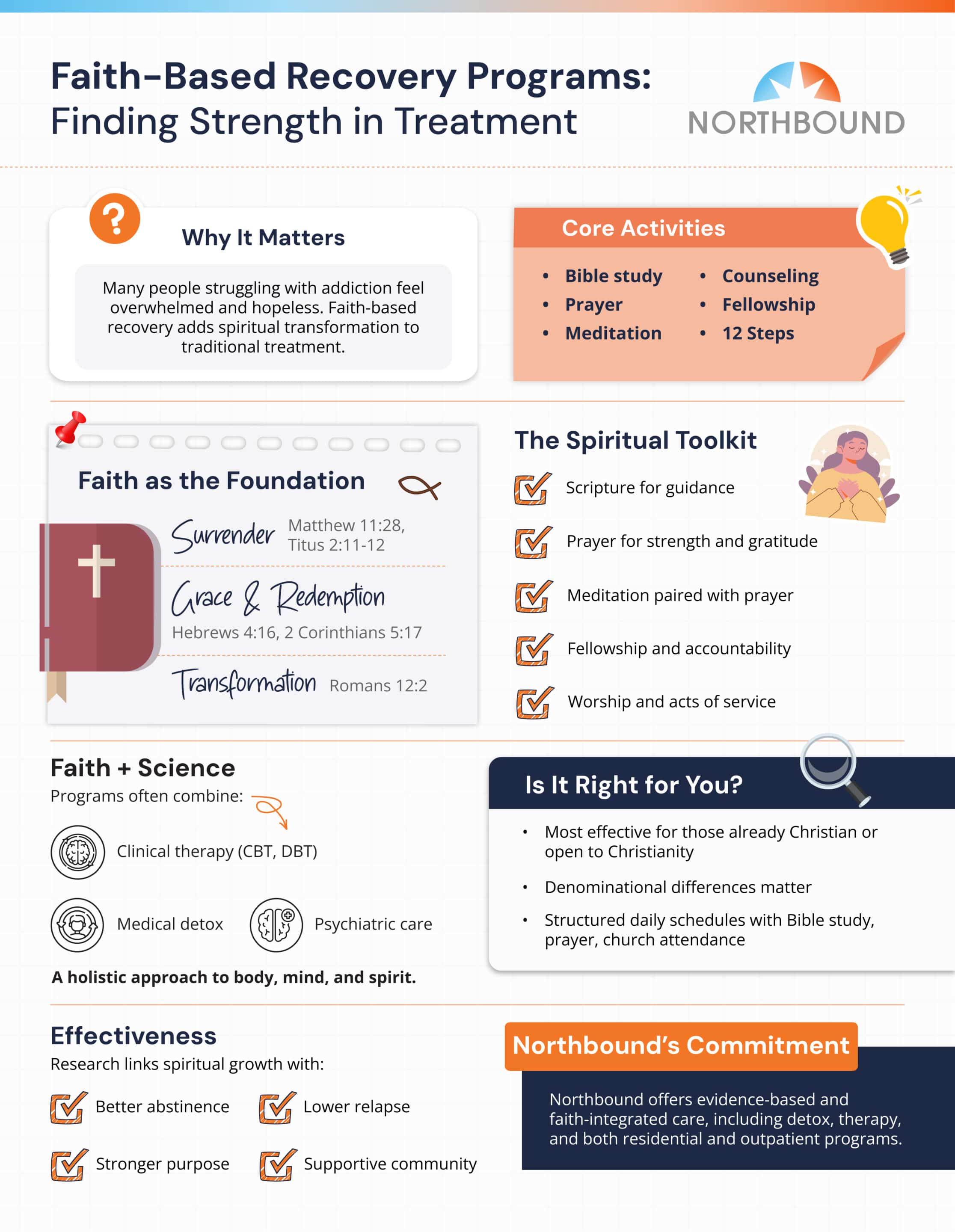
Faith-based programs include Bible study, prayer, meditation, counseling, fellowship, and 12-step program elements focused on surrendering to God, forgiveness, and redemption.
These activities are all aimed at:
In this article, I review the foundation principles of a faith-based approach, reference some core teachings with scripture, and discuss the integration of faith with science in recovery programs.
Christian faith-based centers work from the belief that true recovery comes from a relationship with God through Jesus Christ. So addiction is not just a disease, it’s a form of spiritual brokenness or separation.
Several core principles that guide this belief, with supporting biblical references (NIV), include [2]:
Admitting powerlessness over the addiction and surrendering control to God is often the first step. This is viewed as relief, not weakness.
Matthew 11:28: “Come to me, all you who are weary and burdened, and I will give you rest.” Those carrying the heavy burden of addiction are invited to surrender their struggles to Jesus to obtain renewal.
Titus 2:11-12: “For the grace of God has appeared that offers salvation to all people. It teaches us to say ‘No’ to ungodliness and worldly passions, and to live self-controlled, upright and godly lives in this present age.” The foundation for self-control in recovery is an invitation to surrender to God’s grace.
Individuals are loved and worthy of forgiveness, regardless of their past. Such redemption is a path past the shame and guilt of addiction.
Hebrews 4:16: “Let us then approach God’s throne of grace with confidence, so that we may receive mercy and find grace to help us in our time of need.” Especially during the weakness of addiction, God’s grace is available to provide strength and healing.
2 Corinthians 5:17: “Therefore, if anyone is in Christ, the new creation has come: The old has gone, the new is here!” Here, the Bible refers to the fresh start offered by the transformational power of redemption through Christ.
The goal is a renewed mind and spirit, not just abstinence, as in:
Romans 12:2. “Do not conform to the pattern of this world, but be transformed by the renewing of your mind. Then you will be able to test and approve what God’s will is—his good, pleasing and perfect will.”
The following practical elements are typical of a Christian faith-based substance abuse treatment program that integrates biblical principles with evidence-based clinical care. The emphasis is on forgiveness, grace, and redemption to overcome shame and guilt.
Most modern faith-based programs are not anti-science. Many programs integrate:
Faith-based treatment programs can increase religiosity and spiritual growth. These are linked to better abstinence post-treatment and overall recovery outcomes. Research shows that such programs help recovering addicts replace addiction with [1]:
This spiritual development complements medical and psychological treatment, contributing to long-term sobriety.
Some research shows that Christian faith was a stronger predictor of long-term sobriety than demographic or situational factors in one study. Spiritual practices also contribute to reduced relapse rates and increased treatment adherence [3].
Another study reported that faith-based involvement is linked to as much as eight times lower likelihood of illegal drug use and five times lower likelihood of binge drinking. The authors stated, “In our review of hundreds of studies and extensive data, we found that religious beliefs, behaviors, and belongings significantly reduce risk of substance use and significantly help recovery” [4].
addiction often masks a deep spiritual longing. Christian recovery programs offer a powerful source of strength and support.
As a loved and capable child of God, individuals no longer need to struggle through life without a substance. The strength for recovery is found not from within alone, but from a divine source that believers call their rock and redeemer.
At Northbound, we have extensive experience helping patients overcome their substance abuse addictions, and with a Christian faith-based track for those wishing to participate.
The first steps are detoxification and stabilization, under 24-hour medical supervision in our Withdrawal Management center for whatever time you may require.
We offer a wide range of evidence-based therapies, counseling, and trauma-informed support to assist you in your healing. We personalize each treatment plan around the needs of our patients.
Our inpatient residential program offers 24/7 live-in treatment for substance abuse. Our outpatient treatment provides a flexible step-down from our residential program, allowing you to live at home and participate for several hours a day.
For more than 30 years, Northbound Treatment Services in California has been at the forefront of providing lifesaving, compassionate residential care and specialized services to help people from all walks of life feel better, discover themselves, and live free from addiction.
We have facilities located throughout California to help guide you on your recovery journey. Reach out to our admissions team now.
Yeung J. W. K. (2022). Faith-based intervention, change of religiosity, and abstinence of substance addicts. Revista brasileira de psiquiatria (Sao Paulo, Brazil : 1999), 44(1), 46–56. Holy Bible. New International Version. Biblica 2011 Casiano, N., & Sanderson, J., (2025). The Impact of the Christian Faith on Relapse Prevention and Long-Term Sobriety. J Soci Work Welf Policy, 3(1): 148. Grim, B. J., & Grim, M. E. (2019). Belief, Behavior, and Belonging: How Faith is Indispensable in Preventing and Recovering from Substance Abuse. Journal of religion and health, 58(5), 1713–1750.
About the Author
President, CEO & Founder at Northbound Treatment Network Paul Alexander is the CEO, President & Founder of Northbound Treatment Network in Newport Beach, California. He believes wholeheartedly in transformational leadership, organizational health and effective, fully integrated substance use disorder and mental health treatment. With over 27 years of experience in behavioral healthcare, Paul has extensive knowledge of “in vivo” treatment modalities, clinical development, operations, strategy, marketing and financial planning. He has been widely recognized for his development of collegiate-based residential treatment programs for students in recovery and authored a research study at The University of California confirming this modality’s effectiveness. Paul’s comprehensive professional experience, willingness to innovate, and emphasis on organizational health are vital factors in Northbound’s continued success. Paul received his Certified Addiction Treatment Specialist training at Saddleback College in Mission Viejo, CA, and was awarded Outstanding Alumni Service Award in 2002. Paul holds a Bachelor of Arts degree in Criminology, Law and Society, Summa Cum Laude, from University of California, Irvine, and a Juris Doctorate degree from Loyola Law School of Los Angeles. Paul currently serves on The National Association of Addiction Treatment Providers (NAATP) board. In addition, he serves on The Family Recovery Foundation board and The CarePossible board in Orange County; both organizations are committed to raising funds for family recovery and treatment for former military personnel. Paul is in recovery himself and lives in Orange County with his wife Silvana and his two young sons, Noah and Dean.
In This Article
Tags
What is percocet? Learn what it treats, how it works, risks like overdose, and signs of tolerance or dependence.

Alcohol withdrawal can be dangerous. Learn symptom stages, typical timeline, severe signs like seizures, and when detox is needed.

Codeine is an opioid that can cause drowsiness and slowed breathing. Learn effects, risks, and signs use is becoming addiction.


Take the Next Step
Our admissions team is available 24/7 — confidential, no-obligation, and judgment-free. Let us help you or your loved one find the right path forward with medical detox, residential treatment, or outpatient care in Orange County.