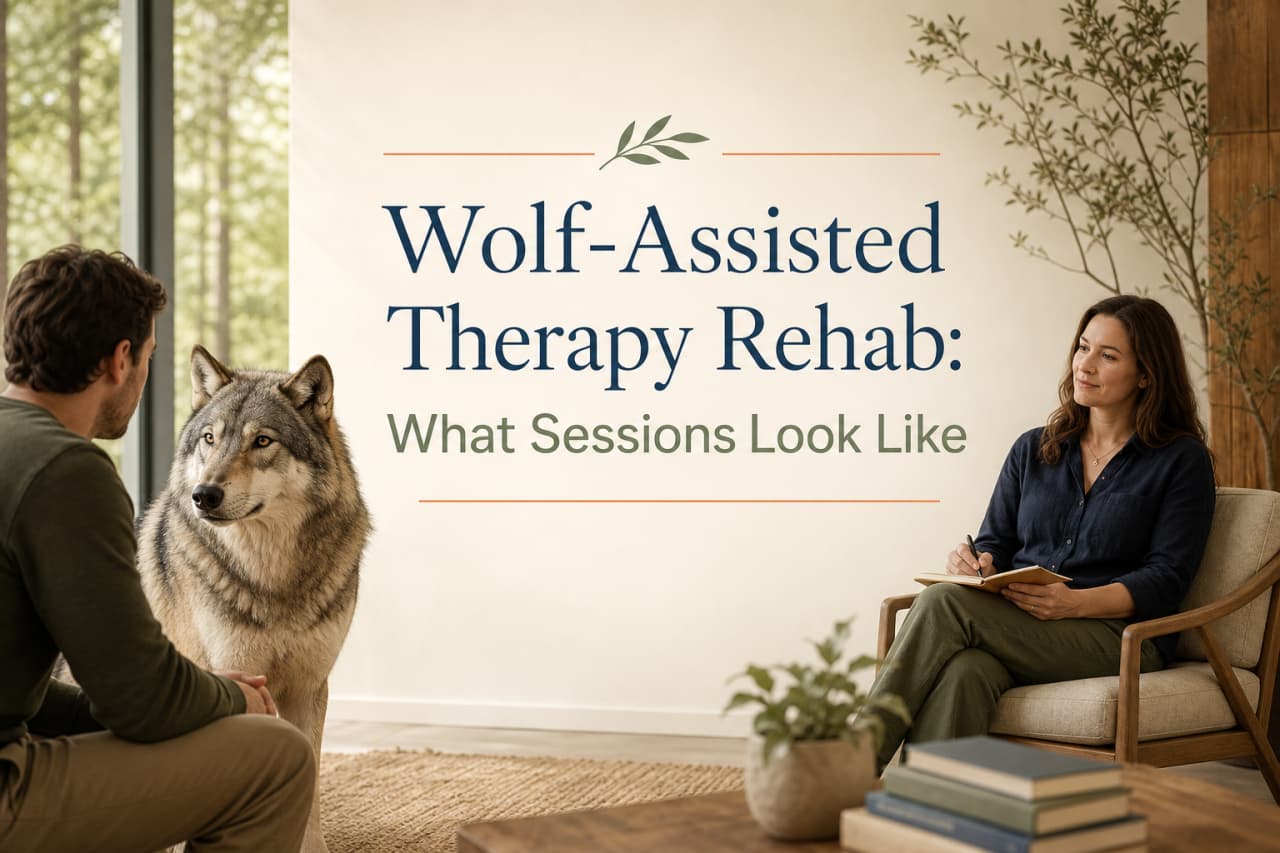
A wolf’s ears twitch before a client even speaks. That sensitivity to emotion drives wolf-assisted therapy rehab at Northbound Treatment and shapes the way these sessions work within the residential program. The animal reads nervous system cues, not stories.
Many clients arrive after years spent hiding pain or performing stability. They’ve learned to mask anxiety, suppress grief, and act like everything is fine. Wolves don’t buy it. They react to what’s happening in the nervous system, not to the story someone tells. That difference—the gap between the outside and the inside—becomes the ground for real therapeutic work.
What Wolf-Assisted Therapy Means Here
Wolf-assisted therapy rehab falls under animal-assisted therapy, a field with a growing research base in clinical settings. Animal-assisted interventions have been studied for their effects on anxiety, PTSD, and emotional regulation, showing patterns like lower cortisol and better social engagement. At Northbound, the work involves wolf ambassadors—wolves socialized for structured human interaction—rather than domestic animals.
That matters. Wolves live by pack rules. They’re tuned in to hierarchy, trust, and whether someone’s emotions match their words. When a client walks in holding back fear or anger, the wolf responds to that tension—not the language used to describe it. This feedback loop is what makes the therapy effective.
Sessions draw on cognitive-behavioral principles alongside animal-assisted therapy research. The point isn’t novelty. It’s to make unconscious biological responses visible, so clients can start working with them directly.
What Actually Happens in a Session
Every session is supervised. An experiential therapist leads the process, and a wolf handler monitors both the animal and the client throughout. No one walks in cold. Orientation comes first, and participation is always voluntary. Sessions take place at The Grove, Northbound’s residential facility in Garden Grove, California, where the therapy team works closely with each client. Each session is scheduled in advance and typically lasts about an hour.
Sessions start with grounding. Clients practice a brief body-awareness exercise before meeting the wolf ambassador. This step isn’t a ritual—it gives the therapist a baseline read on the client’s state and helps the client stay present. Trauma histories are reviewed ahead of time, and the therapist adapts the session as needed.
Once in the space, clients watch the wolf as much as the wolf watches them. The animal’s behavior becomes information. Sometimes the wolf approaches. Other times, it keeps its distance. These reactions open up conversations that talk therapy might never reach. For someone used to analyzing their trauma, a wolf’s quiet withdrawal can say more than any question.
Boundary work is constant. Wolves communicate through body language, distance, and posture. Clients learn to read those cues and respond, practicing the same skills needed to set boundaries with people. It’s hands-on, not abstract, which helps clients who struggle to apply boundary concepts in traditional therapy.
“A wolf doesn’t respond to the story you tell about yourself. It responds to the state your body is actually in.”
Why Trauma Work and Wolves Connect
Northbound’s clinical approach recognizes trauma as a root cause in most substance use disorders. That shapes every part of the program, including wolf-assisted therapy rehab. This modality is especially relevant for clients whose trauma responses are stored in the body, outside conscious memory, because the work happens on a non-verbal level. At The Grove, Northbound’s residential facility in Garden Grove, the clinical team coordinates care so that animal-assisted sessions fit into a broader trauma-informed plan.
Research on somatic trauma responses shows that talk therapy often can’t reach the parts of the nervous system where trauma lives. Approaches that involve the body directly, like animal-assisted work, EMDR, or somatic yoga, can access material that standard therapy misses. At Northbound, wolf-assisted therapy rehab is coordinated with EMDR and trauma-informed individual therapy as part of a larger plan, not as a standalone experience.
Clients often notice something less clinical but just as real: the wolf doesn’t judge. For people carrying shame about substance use or past mistakes, being met by a living creature that simply responds to the present moment can be disarming. Shame tends to dissolve faster when there’s no judgment in the room.
Who Benefits Most from Wolf-Assisted Therapy Rehab
Wolf-assisted therapy rehab isn’t for everyone, and Northbound doesn’t offer it as a default. It’s most helpful for people who struggle to access emotion through words, clients with complex trauma or PTSD, and those who have built strong defenses against feeling. It can also support clients working on trust, especially if their trauma involved betrayal by people who were supposed to be safe. At Northbound’s Garden Grove location, the therapy team screens each participant to decide if this approach is a good fit. Northbound Treatment has provided residential care for nearly four decades, giving the clinical team deep experience in matching clients to the right therapies.
Clients with severe animal phobias or trauma histories involving animals are carefully assessed before participation is suggested. The clinical team reviews each person’s history and readiness before scheduling a session. This isn’t a standard feature for every residential client, it’s one tool among many, chosen for those who might benefit.
Young adults often respond strongly to experiential therapies. For someone whose substance use began in adolescence and who has little practice naming emotions, interacting with a wolf can open doors that years of talk therapy haven’t budged.
How Wolf-Assisted Therapy Rehab Fits the Program
Wolf-assisted therapy is part of Northbound’s experiential therapy program, offered during residential treatment at The Grove in Garden Grove, California. The experiential track also includes adventure therapy, surf sessions, art and music therapy, and somatic yoga. These aren’t just activities, they’re clinically framed and debriefed with a therapist.
The model is InVivo®, Northbound’s signature approach, meaning “in life.” Instead of isolating clients from real-world challenges, InVivo® brings real experiences into a supported setting. Wolf-assisted therapy fits this model: it’s an unpredictable, emotionally charged interaction, managed with clinical support.
Residential treatment at Northbound usually lasts 30 to 90 days. During that time, clients work with a team of up to six clinicians, including a licensed primary therapist, trauma therapist, ASAM-certified addiction psychiatrist, and addictions counselor. Wolf-assisted sessions are coordinated with this team, so anything that surfaces is integrated into the broader treatment plan.
Wolf-assisted therapy is available as part of residential treatment at The Grove. Your treatment team decides if it’s appropriate for your history and goals.
There’s also an advocacy angle. Wolves face stigma, misunderstood, feared, often reduced to a single negative story. Clients who work with wolf ambassadors often find themselves correcting those myths with friends and family. That parallels addiction recovery. Northbound names it directly: the work of challenging misconceptions about wolves mirrors the work of challenging stigma around substance use.
Safety and Supervision
The wolf ambassadors in these sessions are socialized animals handled by specialists trained in their care and behavior. Sessions are always supervised. The experiential therapy director oversees the program, and every session includes both a clinical therapist and an animal handler. Northbound Treatment operates under license 300661CP, issued by the State Department of Health Care Services (DHCS), and maintains strict adherence to safety protocols.
Animal-assisted therapy programs in clinical settings follow established safety protocols set by organizations that certify handlers and animals for therapeutic work. Northbound’s approach matches those standards. Clients are briefed on how to move, how to read the wolf’s body language, and what to do if they feel uncomfortable. Opting out is always an option.
No session is meant to provoke fear. The value comes from genuine interaction, not stress exposure. If a client feels anxious around the wolf ambassador, that anxiety is addressed in real time with a therapist present. No one is pushed through discomfort without support.
What People Want to Know
Is wolf-assisted therapy available to all residential clients at Northbound?
No. The clinical team reviews each client’s history, trauma background, and treatment goals before recommending it. It’s one tool among many, and your primary therapist will discuss whether it fits your plan.
Do clients actually touch the wolves?
Physical contact can happen, but it isn’t the focus. The value comes from interaction, how the wolf responds to a client’s emotional state, not from touch. Sessions are structured around what’s clinically useful, not what’s dramatic.
How does wolf-assisted therapy relate to other trauma treatments at Northbound?
It’s coordinated with EMDR, somatic yoga, individual trauma therapy, and DBT skills work. Insights from wolf-assisted sessions are brought to the primary therapist for integration. The modalities work together, not in isolation.
What if a client is afraid of wolves or large animals?
Clients with significant animal phobias or related trauma histories are assessed before participation is recommended. The clinical team won’t schedule a session that could retraumatize rather than help. Participation is always voluntary.
Is this covered by insurance?
Wolf-assisted therapy is part of the residential treatment program at Northbound, which is covered by most major insurance plans accepted in-network, including Aetna, Cigna, BlueCross BlueShield, and others. Insurance verification is free and usually completed within about one business hour. Call (866) 311-0003 to check your benefits.
Where does wolf-assisted therapy fit in the treatment timeline?
Sessions are usually scheduled after a client has stabilized in early residential treatment and has an established relationship with their primary therapist. The timing depends on clinical readiness, not a set schedule.
Northbound Treatment has provided residential care for nearly four decades. Wolf-assisted therapy rehab stands out, not because it’s unusual, but because it reaches places that standard clinical tools sometimes can’t. For details on the full experiential approach, visit the wolf-assisted therapy page or see what residential treatment at The Grove involves on the residential treatment program page.
If you are in a crisis, please call 988 or 911. The information on this page is not a substitute for professional medical advice.
Ready to talk?
Connect with our team to discuss wolf-assisted therapy rehab and the experiential program at Northbound.