
Guides
November 2, 20267 min read
Stepping Down From Residential to PHP: Timeline Factors
Clinical stability, daily function, housing, and team review shape when PHP becomes appropriate after residential care.
NT
Northbound TreatmentNorthbound Treatment
Editorial Team
Use safety, withdrawal risk, home stability, and treatment engagement to decide if residential care should follow a return to use.
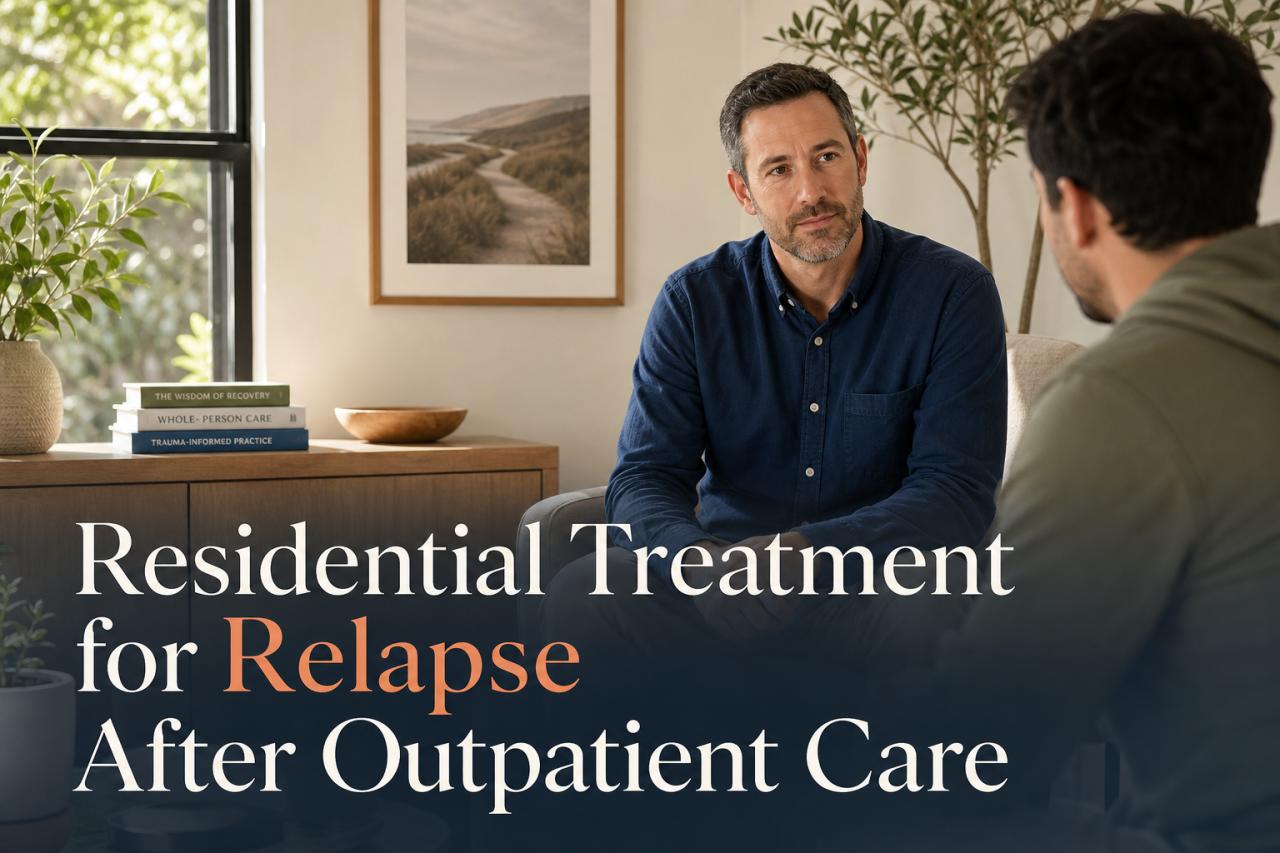
If substance use returns while you're in outpatient care, residential treatment for relapse after outpatient care gives you 24-hour structure, daily clinical contact, and distance from the triggers that undid the earlier plan. Outpatient programs leave long stretches between sessions, and that's where most recurrences happen.
Many people still say relapse, but we prefer return to use or recurrence. Those phrases name what happened without defining the person, and a recurrence tells the treatment team where the earlier plan fell short.
A return to use means the treatment plan needs a prompt clinical reassessment. It doesn't prove outpatient care was wasted or that recovery is out of reach. The National Institute on Drug Abuse notes that a return to drug use can mean treatment should resume, change, or shift to another approach.
Between sessions, you may be near easy substance access, relationship conflict, unstable housing, work stress, or people who are actively using. Depression, anxiety, PTSD, or intense cravings can also get harder to manage without daily clinical contact.
At Northbound Treatment in Garden Grove, CA (DHCS license 300661CP), admission includes a biopsychosocial assessment and a psychiatric evaluation. The team reviews your substance use pattern, physical health, mental health symptoms, living situation, how you responded to earlier treatment, and whether you can stay safe between appointments.
“Use the recurrence as data.”
Residential care fits when the hours outside outpatient treatment keep undoing the work done in sessions. A single episode doesn't set placement by itself. The pattern of use, medical risk, home setting, and ability to stay engaged matter more.
| Signal | Why it changes the decision |
|---|---|
| Substance use continues or escalates between sessions | A few weekly treatment hours may provide too little structure for the current risk. |
| The home setting includes easy substance access or active use | Residential placement creates distance from immediate triggers while new coping skills develop. |
| Appointments are missed or recovery plans are not followed | Daily programming and 24-hour staff support can rebuild routine and accountability. |
| Depression, anxiety, PTSD, or mood symptoms are worsening | A residential team can address substance use and co-occurring mental health needs together. |
| Stopping use may cause withdrawal | A medical assessment can determine whether detox should happen before residential care. |
Clinicians use the ASAM Criteria to match treatment intensity with medical needs, emotional symptoms, recurrence risk, and the recovery environment. Northbound's continuum includes detox, residential care, partial hospitalization, intensive outpatient treatment, sober living, online treatment, and aftercare, and your placement can change as your condition does.
A medical assessment should come first whenever stopping substance use could cause withdrawal. Alcohol and benzodiazepine withdrawal can become life-threatening, and opioid withdrawal or withdrawal involving several substances also needs a clinical plan based on what you used, how much, and when you last used.
Northbound provides medically supervised drug and alcohol detox at The Grove in Garden Grove. Detox usually lasts 5 to 10 days and includes 24/7 medical monitoring, daily therapeutic support, dual-diagnosis screening, and medication-assisted treatment when it's clinically indicated.
Detox clears the way for treatment, but it doesn't resolve the triggers, trauma, thought patterns, or living conditions tied to the recurrence. The team plans your move into residential care while you're still in detox, so you leave that phase with a clinical plan.
Don't try to manage potentially dangerous withdrawal alone. Seek medical guidance. If you are in a crisis, please call 988 or 911.
The team starts by working out why the previous level of care couldn't contain the risk. At Northbound, residential treatment at The Grove usually lasts 30 to 90 days, and you live on-site with 24-hour support and daily clinical programming.
Your treatment team can include up to six clinicians, among them an addiction psychiatrist, a licensed primary therapist, a trauma therapist, an addictions counselor, and case management support. Care can include individual therapy, group counseling, psychoeducation, DBT, EMDR, experiential therapy, and 12-Step engagement.
Early goals depend on what drove the recurrence. One person may need medication management and trauma care, while another needs stronger boundaries, a different living plan, and repeated practice responding to cravings. The written plan should target those actual failure points instead of repeating the same outpatient schedule.
Dual diagnosis care is part of every Northbound treatment plan. Substance use can intensify anxiety, depression, PTSD, or mood instability, and those symptoms can raise the urge to use. Treating both gives the clinical team a clearer basis for discharge decisions.
Say your outpatient therapist helps you name a trigger on Tuesday afternoon, and you face it alone on Wednesday night. In residential care, clinicians see your patterns across the whole day and can respond close to when they appear.
Northbound's InVivo® model means "in life." Phones, social contact, independent activities, and real-world responsibilities return gradually under clinical guidance, so your recovery skills get tested before discharge instead of after you're back in the setting that preceded the recurrence.
Discharge planning starts weeks before you leave. The team coordinates therapy referrals, partial hospitalization or intensive outpatient placement, sober living when it's appropriate, recovery meetings, family support, and alumni contact. Because the continuum stays under one clinical team, you step down without rebuilding your treatment history with a new provider.
“Structure changes the equation.”
Families should address immediate safety, write down what changed, and request a level-of-care assessment by calling (866) 311-0003. Arguments about broken promises rarely show whether withdrawal, psychiatric symptoms, substance access, or an unstable home now call for residential placement.
Give the admissions team concrete observations. Report changes in sleep, attendance, how often substances are being used, medication use, behavior, housing, and willingness to attend treatment. Skip guessing at a diagnosis, because specific facts help clinicians assess risk.
Northbound's Family Program includes four days of programming each month for families of residential clients, at no added cost. Sessions cover communication, codependency, family roles, boundaries, and conflict, and a Wednesday evening Family Support meeting continues by Zoom after discharge.
You can support treatment without taking over every consequence. Clear boundaries state what you'll do, what you won't do, and which treatment options you'll back, and a family clinician can help you put them into plain language.
Verify benefits before assuming residential care is covered or out of reach. Coverage depends on your plan, medical necessity, authorization requirements, and deductible. Northbound explains your benefits in plain language before admission, and verification is typically completed within about one business hour when you reach admissions at the same number.
Northbound accepts Aetna, Anthem, BlueCross BlueShield, Cigna, Compsych, First Health Network, GEHA, Health Net, ILWU, Magellan, MHN Insurance, NYSHIP, Premera Blue Cross, TriCare, and USAMCO. Acceptance doesn't guarantee payment for a specific level or length of care, and Northbound can't accept Medicare or Medicaid at this time.
The pre-admission assessment is free and confidential. An admissions representative reviews treatment history, recent substance use, co-occurring symptoms, medical concerns, and practical needs. Same-day admission may be available when the clinical and travel details can be completed safely.
One recurrence doesn't automatically require residential placement. A clinician should assess withdrawal risk, frequency of use, mental health symptoms, home stability, and whether you can remain safe between outpatient sessions.
Northbound residential care usually lasts 30 to 90 days. The clinical team bases length on ASAM criteria, progress, co-occurring conditions, living circumstances, and the next planned level of care.
Yes. Many clients step down from residential treatment to partial hospitalization, intensive outpatient care, sober living, or online treatment once they can manage more independence safely.
Northbound integrates dual diagnosis care into every treatment plan. The clinical team can address substance use alongside anxiety, depression, PTSD, bipolar disorder, borderline personality disorder, and other co-occurring conditions within its scope of care.
Bring identification, insurance and prescription cards, approved prescription medications, comfortable clothing, toiletries, and emergency contact information. Northbound sends a full packing list after the intake call.
Website information provides general education and can't replace medical advice, diagnosis, or a personal level-of-care assessment from a qualified clinician.
Northbound's admissions team is available 24/7 at (866) 311-0003. A confidential assessment can clarify whether you need detox, residential care, or a revised outpatient plan after a return to use.
About the Author
Helpful educational resources from Northbound Treatment.
In This Article
Tags
Clinical stability, daily function, housing, and team review shape when PHP becomes appropriate after residential care.

Phone access often changes by treatment phase. Ask about device rules before admission, how family contact works, and what to pack.

Mornings, therapy blocks, meals, family programming, and evenings at Northbound's Garden Grove campus follow a clear residential rhythm.
Take the Next Step
Our admissions team is available 24/7 — confidential, no-obligation, and judgment-free. Let us help you or your loved one find the right path forward with medical detox, residential treatment, or outpatient care in Orange County.